2.2. Memory Architecture
Memory architecture in PostgreSQL can be classified into two broad categories:
- Local memory area: Allocated by each backend process for its own use.
- Shared memory area: Used by all processes of a PostgreSQL server.
The following subsections provide a brief description of each category.
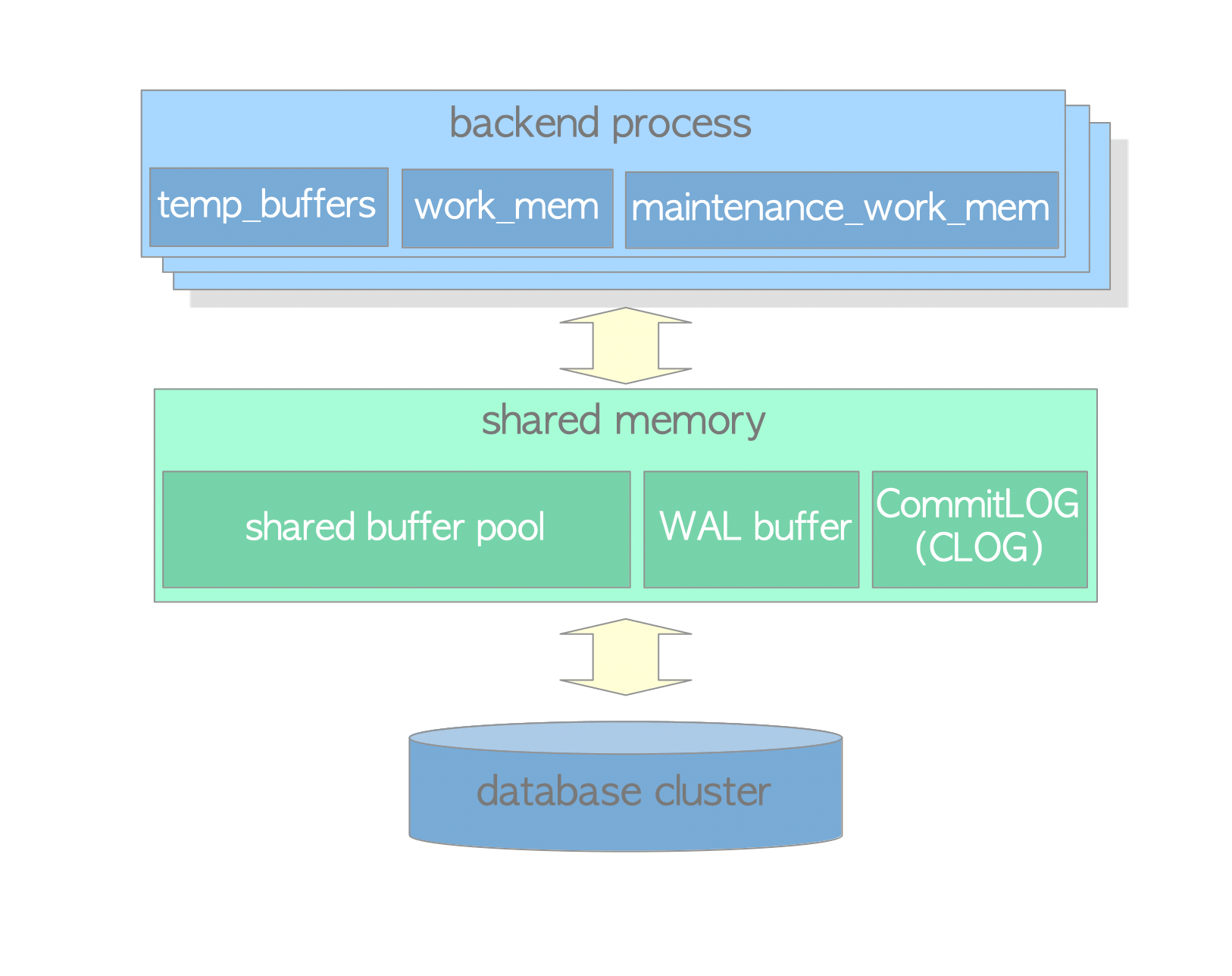
Figure 2.2. Memory architecture in PostgreSQL.
2.2.1. Local Memory Area
Each backend process allocates a local memory area for query processing. The area is divided into several sub-areas, whose sizes are either fixed or variable.
Table 2.2 lists the primary sub-areas. Further details regarding these areas are provided in the subsequent chapters.
| sub-area | description | reference |
|---|---|---|
| work_mem | Used by the executor for sorting tuples in ORDER BY and DISTINCT operations, and for joining tables via merge-join and hash-join operations. | Chapter 3 |
| maintenance_work_mem | Used by various maintenance operations, such as VACUUM, REINDEX, and index creation. | Section 6.1 |
| temp_buffers | Used by the executor to store temporary tables for the duration of a session. |
In addition, Dynamic Shared Memory (DSM) was introduced in version 9.4 to support Parallel Query.
DSM is an on-demand memory space (allocated as needed and released when no longer required) used for inter-process communication between PostgreSQL processes.
2.2.2. Shared Memory Area
A shared memory area is allocated by the PostgreSQL server during startup. This area is divided into several fixed-size sub-areas. Table 2.3 lists the primary sub-areas, with further details provided in the subsequent chapters.
| sub-area | description | reference |
|---|---|---|
| shared buffer pool | PostgreSQL loads pages from tables and indexes from persistent storage into this area to operate on them directly. | Chapter 8 |
| WAL buffer | To ensure data integrity against server failures, PostgreSQL employs a Write Ahead Logging (WAL) mechanism. WAL data (also referred to as XLOG records) constitutes the transaction log. The WAL buffer serves as a temporary storage area for WAL data before it is flushed to persistent storage. | Chapter 9 |
| commit log | The commit log (CLOG) maintains the state of all transactions (e.g., in-progress, committed, aborted) for the Concurrency Control (CC) mechanism. | Section 5.4 |
In addition to these primary areas, PostgreSQL allocates several other sub-areas for specific purposes:
- Access control mechanisms: For managing semaphores and various locks (e.g., lightweight locks, shared locks, and exclusive locks).
- Background processes: For coordinating tasks performed by processes such as the checkpointer and autovacuum.
- Transaction processing: For managing internal states such as savepoints and two-phase commits.